


Police in Portugal Resume Search for Madeleine McCann, British Child Missing Since 2007 

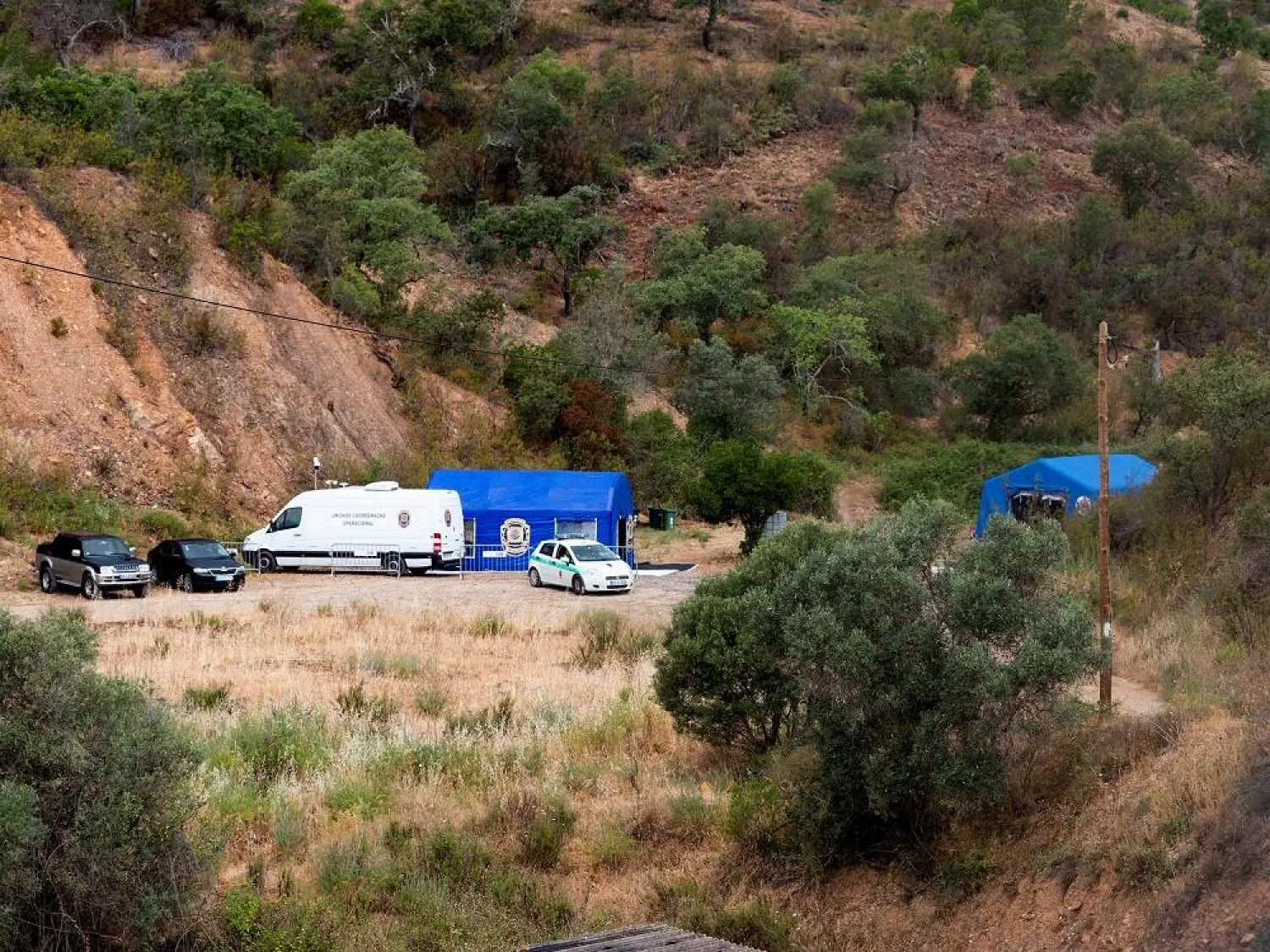
Vehicles and tents of Portugal's investigative Judicial Police are seen at the site of a remote reservoir where a new search for the body of Madeleine McCann is set to take place, in Silves, Portugal, in this screen grab from a video, May 22, 2023. (Reuters)
TT

Police in Portugal Resume Search for Madeleine McCann, British Child Missing Since 2007 

Vehicles and tents of Portugal's investigative Judicial Police are seen at the site of a remote reservoir where a new search for the body of Madeleine McCann is set to take place, in Silves, Portugal, in this screen grab from a video, May 22, 2023. (Reuters)

Portuguese police aided by German and British colleagues on Tuesday resumed their search for Madeleine McCann, the British child who disappeared in the country’s southern Algarve region 16 years ago.

Between 20 and 30 officers, some in uniform, could be seen in the area by the Arade dam, about 50 kilometers (30 miles) from Praia da Luz, where the 3-year-old was last seen alive in 2007.

Portuguese police had set up a blue base tent and cordoned off the area to the media and public. Eyewitnesses said police began searching shortly before 8 a.m. Tuesday in an area some kilometers (miles) away from the tent. More than a dozen cars and police vans could be seen arriving in the area.

On Monday, Portugal’s Judicial Police issued a statement saying the search was being resumed at the request of German authorities and with help from British officials.

German prosecutors in Braunschweig said in a written statement Tuesday that “criminal procedural measures are currently taking place in Portugal as part of the investigation into the Madeleine McCann case.”

They added that “the measures are being implemented by way of mutual legal assistance by the Portuguese prosecution authorities with the support of officers from the Federal Criminal Police Office.”

“More detailed information on the background is not being released at this time for investigative tactical reasons,” the statement said.

In mid-2020, German officials said a 45-year-old German citizen, identified by media as Christian Brueckner, who was in the Algarve in 2007, was a suspect in the case. Brueckner has denied any involvement.

Brueckner is currently serving a seven-year prison sentence in Germany for a rape he committed in Portugal in 2005.

He is under investigation on suspicion of murder in the McCann case but hasn’t been charged. He spent many years in Portugal, including in Praia da Luz, around the time of Madeleine’s disappearance.

The case stirred worldwide interest for several years, with reports of sightings of her stretching as far away as Australia, along with a slew of books and television documentaries about the case.

Rewards for finding Madeleine, who would now be 20, reached several million dollars.

British, Portuguese and German police are still piecing together what happened on the night when the toddler disappeared from her bed in the southern Portuguese resort on May 3, 2007. She was in the same room as her twin brother and sister, who were 2 at the time, while her parents had dinner with friends at a nearby restaurant.



Deep-sea Fish Break the Mold with Novel Visual System

A close-up showing the shiny silver-green photophores (light organs) on the lower head of the deep-sea fish Maurolicus muelleri from the Red Sea, seen in this photograph released on February 11, 2026. Dr. Wen-Sung Chung/Handout via REUTERS
TT

Deep-sea Fish Break the Mold with Novel Visual System

A close-up showing the shiny silver-green photophores (light organs) on the lower head of the deep-sea fish Maurolicus muelleri from the Red Sea, seen in this photograph released on February 11, 2026. Dr. Wen-Sung Chung/Handout via REUTERS

For more than a century, biology textbooks have stated that vision among vertebrates - people included - is built from two clearly defined cell types: rods for processing dim light and cones for bright light and color. New research involving deep-sea fish shows this tidy division is, in reality, not so tidy.

Scientists have identified a new type of visual cell in deep-sea fish that blends the shape and form of rods with the molecular machinery and genes of cones. This hybrid type of cell, adapted for sight in gloomy light conditions, was found in larvae of three deep-sea fish species in the Red Sea, Reuters reported.

The species studied were: a hatchetfish, with the scientific name Maurolicus mucronatus; a lightfish, named Vinciguerria mabahiss; and a lanternfish, named Benthosema pterotum. The hatchetfish retained the hybrid cells throughout its life. The other two shifted to the usual rod-cone dichotomy in adulthood.

All three are small, with adults measuring roughly 1-3 inches (3-7 cm) long and the larvae much littler. They inhabit a marine realm of twilight conditions, with sunlight struggling to penetrate into the watery depths.

The vertebrate retina, a sensory membrane at the back of the eye that detects light and converts it into signals to the brain, possesses two main types of light-sensitive visual cells, called photoreceptors. They are named for their shape: rods and cones.

"The rods and cones slowly change position inside the retina when moving between dim and bright conditions, which is why our eyes take time to adjust when we flick on the light switch on our way to the restroom at night," said Lily Fogg, a postdoctoral researcher in marine biology at the University of Helsinki in Finland and lead author of the research published in the journal Science Advances.

"We found that, as larvae, these deep-sea fish mostly use a mix-and-match type of hybrid photoreceptor. These cells look like rods - long, cylindrical and optimized to catch as many light particles - photons - as possible. But they use the molecular machinery of cones, switching on genes usually found only in cones," Fogg said.

The researchers examined the retinas of fish larvae caught at depths from 65 to 650 feet (20 to 200 meters). In the type of dim environment they inhabit, rod and cone cells both are usually engaged in the vertebrate retina, but neither works very well. These fish display an evolutionary remedy.

"Our results challenge the longstanding idea that rods and cones are two fixed, clearly separated cell types. Instead, we show that photoreceptors can blend structural and molecular features in unexpected ways. This suggests that vertebrate visual systems are more flexible and evolutionarily adaptable than previously thought," Fogg said.

"It is a very cool finding that shows that biology does not fit neatly into boxes," said study senior author Fabio Cortesi, a marine biologist and neuroscientist at the University of Queensland in Australia. "I wouldn't be surprised if we find these cells are much more common across all vertebrates, including terrestrial species."

All three species emit bioluminescence using small light-emitting organs on their bodies, mostly located on the belly. They produce blue-green light that blends with the faint background light from the sun above. This strategy, called counterillumination, is a common form of camouflage in the deep sea to avoid predators.

"Small fish like these fuel the open ocean. They are plentiful and serve as food for many larger predatory fishes, including tuna and marlin, marine mammals such as dolphins and whales, and marine birds," Cortesi said.

These kinds of fish also engage in one of the biggest daily migrations in the animal kingdom. They swim near the surface at night to feed in plankton-rich waters, then return to the depths - 650 to 3,280 feet (200 to 1,000 meters) - during daytime to avoid predation.

"The deep sea remains a frontier for human exploration, a mystery box with the potential for significant discoveries," Cortesi said. "We should look after this habitat with the utmost care to make sure future generations can continue to marvel at its wonders."


Japan City Gets $3.6 Mn Donation in Gold to Fix Water System

FILE PHOTO: Factories line the port of Osaka, western Japan October 23, 2017. REUTERS/Thomas White/File Photo
TT

Japan City Gets $3.6 Mn Donation in Gold to Fix Water System

FILE PHOTO: Factories line the port of Osaka, western Japan October 23, 2017. REUTERS/Thomas White/File Photo

Osaka has received an unusual donation -- 21 kilograms of gold -- to pay for the maintenance of its ageing water system, the Japanese commercial hub announced Thursday.

The donation worth $3.6 million was made in November by a person who a month earlier had already given $3,300 in cash for the municipal waterworks, Osaka Mayor Hideyuki Yokoyama told a press conference.

"It's an absolutely staggering amount," said Yokoyama, adding that he was lost for words to express his gratitude.

"I was shocked."

The donor wished to remain anonymous, AFP quoted the mayor as saying.

Work to replace water pipes in Osaka, a city of 2.8 million residents, has hit a snag as the actual cost exceeded the planned budget, according to local media.


Thai Cops Go Undercover as Lion Dancers to Nab Suspected Thief

People gather to watch performers outside Emsphere shopping mall on the first day of the Lunar New Year of the Horse, in Bangkok on February 17, 2026. (Photo by Lillian SUWANRUMPHA / AFP)
TT

Thai Cops Go Undercover as Lion Dancers to Nab Suspected Thief

People gather to watch performers outside Emsphere shopping mall on the first day of the Lunar New Year of the Horse, in Bangkok on February 17, 2026. (Photo by Lillian SUWANRUMPHA / AFP)

Thai police donned a lion dance costume during this week's Lunar New Year festivities to arrest a suspect accused of stealing about $64,000 worth of Buddhist artifacts, police said Thursday.

Officers dressed as a red-and-yellow lion made the arrest on Wednesday evening after receiving a report earlier this month of a home burglary in the suburbs of the capital, Bangkok, AFP reported.

Capital police said the reported break-in involved "numerous Buddhist objects and two 12-inch Buddha statues", along with evidence of repeated attempts to enter the house, according to a statement.

With few leads, police kept watch for weeks before hatching an unusual plan to join a lion dance procession at a nearby Buddhist temple.

"Officers gradually moved closer to the suspect before arresting him," police said.

A video released by police showed the festive lion dancers approaching the suspect before an officer suddenly emerged from the head of the costume and, with help from colleagues, pinned him to the ground.

Police estimated the value of the stolen items at around two million baht ($64,000).

The suspect, a 33-year-old man, has a criminal record involving drug offences and theft, police added.